
Applying for Social Security Disability benefits can feel overwhelming, and one of the most common questions applicants ask is: How long will this take?
Processing times vary by case and location, and understanding these timelines—and knowing how to avoid common delays—can help applicants set realistic expectations and move their claims forward as efficiently as possible.
It’s also important to note that these time lines continually change depending mostly on staffing or the number of employees available at specific offices and in the state agencies who collect and review medical records. At times, the Social Security Administration may shift workloads from an overly busy office to another office with less workload or pending claims.
Initial Stage for a Social Security Disability Application
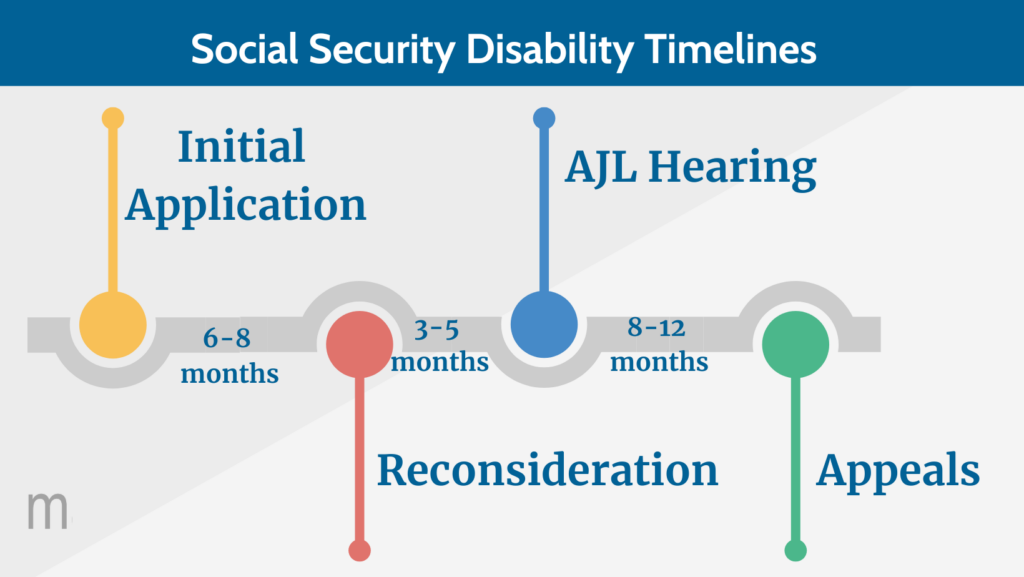
The initial application stage is typically the longest wait for first-time applicants. Nationally, SSA takes approximately 6 to 8 months to issue a decision on an initial disability claim.
During this period, SSA reviews your basic information, then transfers the file to another office which gathers medical records, reviews work history, and may schedule consultative examinations if additional medical evidence is needed.
The time frames above is national, they can vary significantly from state to state. For example:
- In early 2026, claims are taking much longer in Utah, up to 11–13 months
- Nevada appears to be close to the national average 5–7 months
- Idaho is currently processing claims very quickly with an average processing time of 5–6 months
Delays at this stage often occur due to:
- Incomplete applications
- Missing medical records
- Slow responses from medical providers
Approximately 65–70% of initial applications are denied, making careful preparation especially important. The most important part of preparation is providing very clear and complete information about where to get your medical records.
Reconsideration
If an initial claim is denied, the applicant has 60 days to file a Request for Reconsideration.
This stage generally takes 3 to 5 months. A different examiner reviews the claim, but no hearing is involved.
Denial rates are even higher at Reconsideration, nationwide about 85–90% of claims are denied. Many claims proceed to the hearing level.
Hearing Before an Administrative Law Judge (ALJ)
The hearing stage is where many applicants are ultimately approved, but it also involves the longest wait.
From the time a hearing is requested, the national average wait for a decision is 8 to 12 months, depending on the region. However, in Utah the wait for a hearing is closer to 7–9 months.
At the hearing:
- An Administrative Law Judge reviews the full record
- The applicant provides testimony
- Vocational or medical experts may provide evidence
Approval rates are significantly higher at this stage, particularly for applicants who are well prepared and represented.
Appeals Council and Federal Court (If Necessary)
If the ALJ denies the claim:
- Appeals Council review may take a year or longer
- Federal court review can extend the timeline by another year or more
Third-Party Electronic Applications, Claimant Contact, and Signature Requirements
Many disability applications are filed electronically by a third party, such as an attorney, advocate, or representative. While this is permitted, SSA still requires direct claimant involvement to process the claim.
Your claim will not process properly if you do not:
- Speak with Social Security if they call to confirm your identity and intent to file
- Sign the application summary they mail you and return it
When a third party submits an electronic application:
SSA must establish contact with the claimant
SSA generally requires confirmation that the claimant authorized the filing and agrees with the information submitted. This contact may occur by phone, mail, or through SSA’s electronic signature process.
An original signature or electronic attestation is required
SSA cannot process a disability claim without the claimant’s signed authorization. If the application is filed electronically by a third party, SSA typically sends the claimant a signature request (such as Form SSA-827 and/or an electronic attestation) that must be completed and returned.
Delays occur if signature requirements are not met
If SSA cannot reach the claimant or does not receive the required signature, the claim may be placed on hold, delayed, or even technically closed until proper authorization is obtained.
Prompt claimant response is critical
Returning signed forms quickly and responding to SSA contact attempts helps prevent unnecessary processing delays.
Even when a representative handles the filing, the claimant remains a required participant in the process. Claimants will be expected to provide written information about their work history and ability to engage in a variety of activities.
Maintaining availability and responding to SSA communications is essential for the claim to move forward.

Tips to Help Your Claim Move More Quickly and Efficiently
While no one can eliminate all delays, applicants can take several steps to help their claim move as smoothly as possible:
Before You Submit Your Application
- Submit a complete and accurate application.
- List all medical conditions, symptoms, medications, and limitations.
- Be very careful to provide full names of doctors, the clinics where they work and a proper address for the facility.
- Provide detailed medical provider information.
- Full contact details allow SSA to request records quickly.
While Your Claim Is Being Reviewed
- Continue medical treatment.
- Ongoing care creates current medical evidence.
- Respond promptly to SSA requests.
- Missed deadlines are a common cause of delays.
- Attend all consultative exams.
- Failure to attend can stop a claim entirely.
Throughout the Entire Process
- Keep SSA informed of changes.
- Address changes, new providers, or hospitalizations should be reported immediately.
- Stay reachable.
- Answer calls and open mail from SSA, especially if a third party filed the application.
Additional Support
- Consider experienced guidance.
- Proper handling of forms, signatures, and evidence can significantly reduce delays.
Final Thoughts About the SSA Disability Application
Although Social Security disability timelines can be lengthy, delays are common and do not reflect the strength of a claim.
Careful preparation, clear communication, timely signatures, and thorough documentation can make a meaningful difference in how efficiently a case is processed.
Understanding both the national timelines and procedural requirements allows applicants to better navigate the system and focus on their health and financial stability.
Resources to support your Social Security Disability Application process
- Compassionate Allowances Program Adds New Conditions
- Why People Lose Their Social Security Benefits (and How to Avoid It!)
- What Really Happens at Your Disability Hearing with an Administrative Law Judge
- SSA Historical Overview
- SSA: Milestones in Social Security History
- AARP Social Security History Timeline
- Peer-Reviewed Analysis (PubMed